Start with the person viewing your work
The best portfolio format is the one that helps a specific person understand your work with the least effort. Before building anything, ask who will see it and what they need to decide. A prospective client may want relevant examples and a clear way to contact you. A course reviewer may need to assess your process against a brief. A potential teammate may care most about your role, decisions and handoffs.
Think about how you will share the portfolio, too. A website works well as a general link you can put in a profile or email signature. A PDF can be useful when you are responding to a particular opportunity and want to select a few tightly relevant projects. Neither format makes weak work strong: clear project descriptions and deliberate selection matter more than the container.
When a portfolio website makes sense
Choose a website if you want a lasting home for your work that people can browse independently. It can hold a short introduction, several case studies and contact information without squeezing everything onto a fixed number of pages. It also suits work that benefits from interaction, such as a prototype or a sequence of screens. You can link to supporting material while keeping each project page focused.
A website does require upkeep. Check that pages work on small screens, images are readable, links still lead somewhere useful and contact details are current. Make important context visible in text rather than relying on an image to explain it. If a project contains client or team work, confirm what you are allowed to show before publishing it openly. When you cannot share the full result, describe your contribution and use approved or recreated examples instead.
When a PDF is the better tool
A PDF is useful when you need a controlled, self-contained presentation. You can arrange projects in a deliberate order, give each one an appropriate amount of space and tailor the document to the recipient. A freelancer pitching for packaging work, for example, might send a concise PDF featuring relevant packaging projects rather than asking a client to search through a broader website.
PDFs also have limits. A file can become outdated as soon as you revise a project, and different versions can be hard to track. Large images may make it inconvenient to send or open. Design for easy reading: use legible type, explain what each image shows and test the file on a phone as well as a computer. Give it a descriptive filename, and avoid assuming that a recipient will click every embedded link.
Build case studies that work in either format
Whether someone opens a page or a document, they should be able to understand what the project was, what you did and what changed by the end. A compact case study can cover the brief, constraints, your role, a few meaningful decisions and the final outcome. If you worked with others, separate your contribution from the team’s work. If the project was a student exercise or self-initiated concept, label it clearly rather than presenting it as commissioned work.
Choose images to support the story, not just to fill space. Show a final piece where possible, then add a sketch, draft, comparison or workflow example if it helps explain a decision. Write captions that connect the visual to the project. For work without a measurable outcome, describe what you delivered and what you learned without inventing a result. Two well-explained projects can be more useful than a long collection of unexplained images.
Use both formats without doubling the work
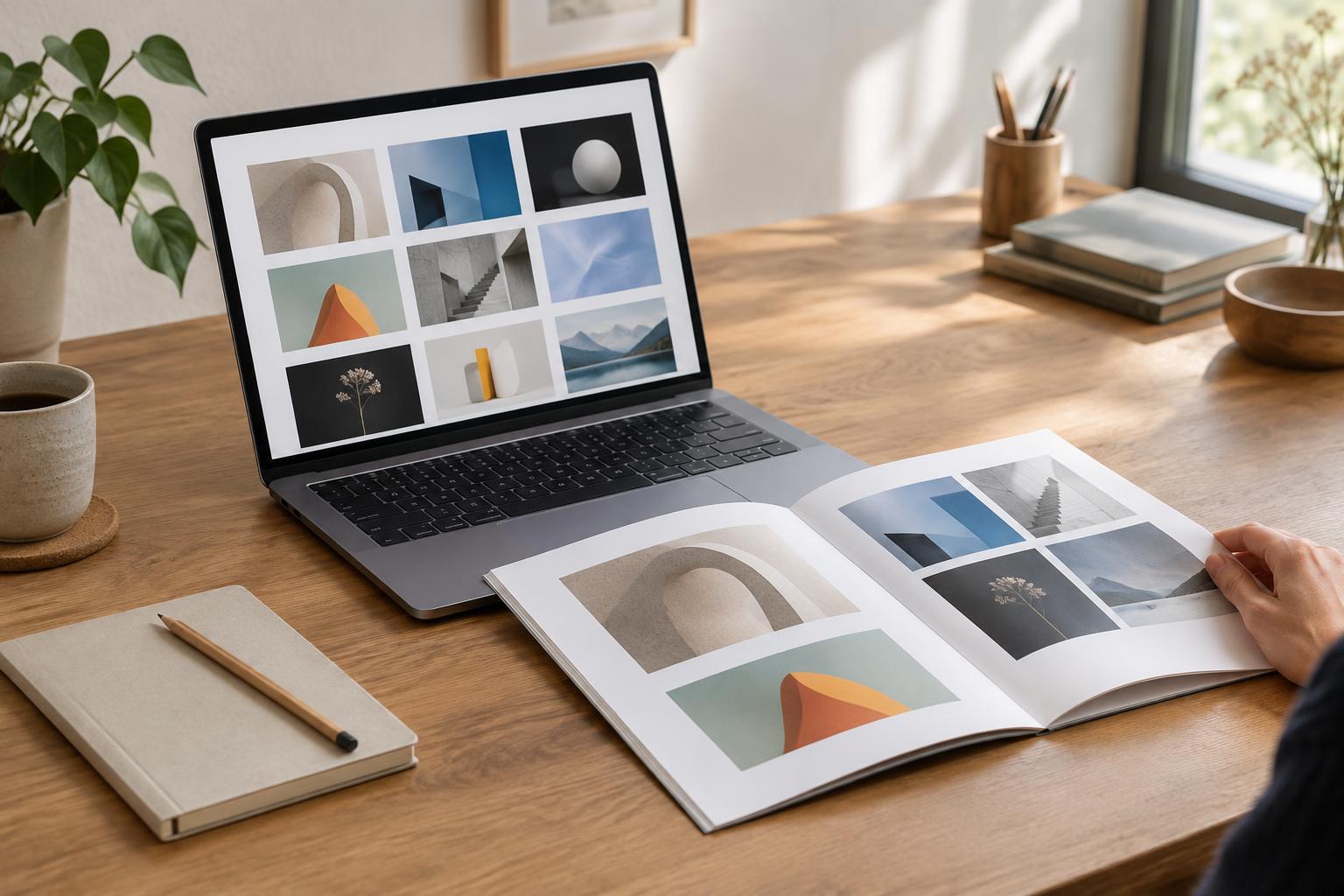
You do not have to make a permanent either-or choice. A student might keep a simple website with their strongest projects and prepare a PDF for a specific application. A small creative team might use its website to introduce its services, then send a tailored PDF showing work relevant to a prospective client’s brief. The key is to maintain one set of accurate project notes, approved images and role descriptions that can feed both formats.
If time is limited, build the format you can finish and maintain. Start with three questions: Who needs to see this? How will they receive it? What evidence will help them understand my contribution? Then make a small first version, ask someone unfamiliar with the projects to review it, and fix anything they cannot understand quickly. A clear, current portfolio is more valuable than an elaborate one that is never ready to share.